
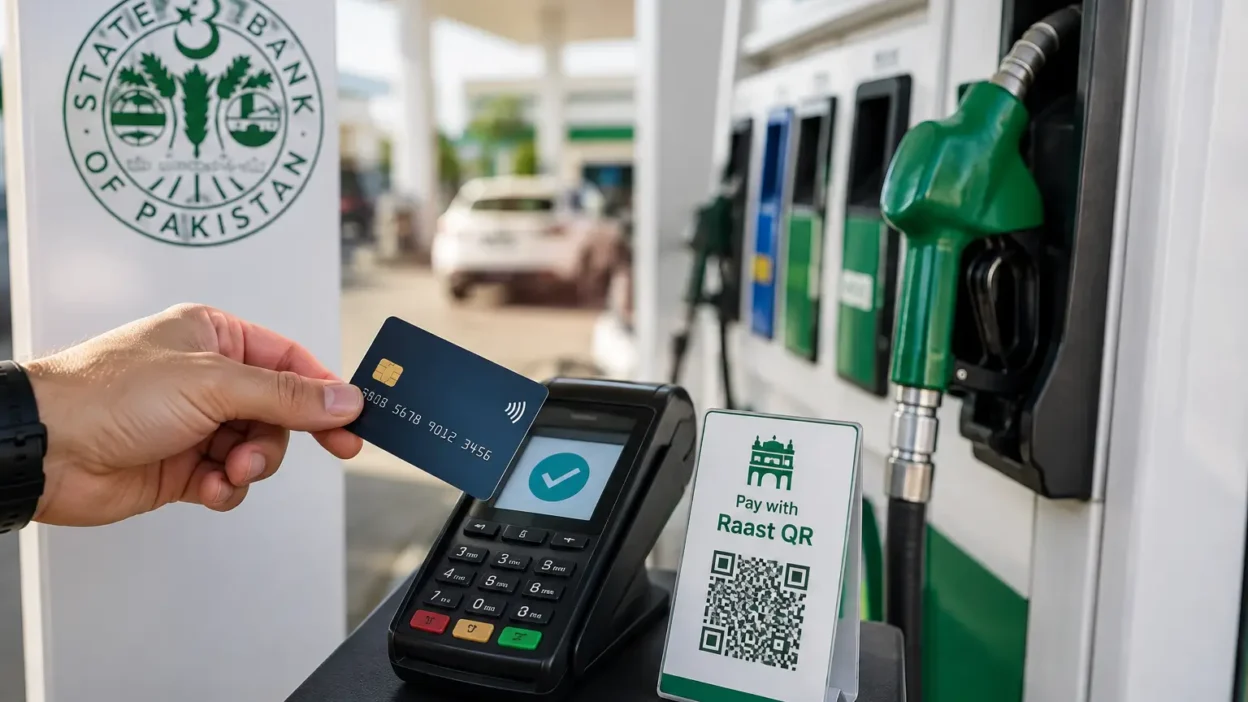
The State Bank of Pakistan (SBP) has launched a new framework to promote digital payments at gasoline stations by reducing transaction fees for card payments and extending Raast QR payment acceptance to petrol pumps nationwide.
The updated regulation would impose a restriction on the Merchant Discount Rate (MDR) for debit and credit card transactions at petrol stations, capping it at Rs. 1 per litre. The Interchange Reimbursement Fee (IRF) on fuel and associated purchases has also been capped at Rs. 0.20 per litre.
The central bank has also asked commercial banks to closely coordinate with gasoline station operators to facilitate Raast QR payment services, enabling clients to make digital payments using Pakistan’s rapid payment system.
SBP said these unique pricing arrangements would be operational till January 31, 2027 and would be applicable to all payment cards issued in Pakistan.
The drive aims to speed up the uptake of digital payments in one of the nation’s most cash-reliant sectors. With more than 15,000 fuel stations in Pakistan, point-of-sale terminals are mostly concentrated in larger cities, and many places do not take card payments.
Abdus Samad Khan, a digital payments analyst, said the decision will incentivise fuel stations to set up more POS terminals and QR payment systems. The program will increase customer convenience and reduce cash handling and associated security expenses across the petroleum business, he said.
The Pakistan Petroleum Dealers Association (PPDA) has applauded the State Bank of Pakistan’s decision to cut bank costs on card transactions at petrol stations, terming it a vital step towards encouraging digital payments and financial inclusion across the country.
Petroleum dealers claimed fuel stations are paying around 0.8 per cent in bank charges on card transactions, which works out to around Rs. 2.40 per litre. They said the hefty expenses had put off fuel stations and banks from extending card payment infrastructure.
“The recent decision of SBP would help in promoting the use of digital payments by lowering transaction costs,” stated PPDA Chairman Malik Khuda Baksh. “The association had requested a total waiver of the bank charges; we appreciate the initiative, but we think the fees can be reduced further in consultation with the PPDA,” he said.
The group had formally requested a full waiver in a meeting with representatives of the Oil and Gas Regulatory Authority (Ogra) and the government in the last week of July. The Federal Minister for Petroleum, Bilal Azhar Kayani, had at that time guaranteed the association that the matter would be attended to, and PPDA Chairman Rana Ayub claimed the minister has finally honoured that promise.
The latest SBP data shows the use of cards is steadily growing in Pakistan, with a total of 68.3 million payment cards in circulation, especially in retail.